Is Kant's General Logic Extensional or Intensional?
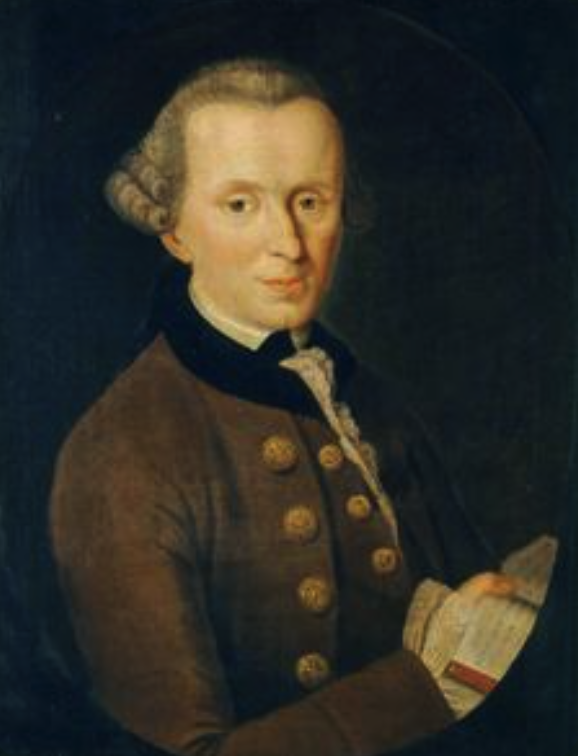
"In respect to expansion and demarcation of our cognition the following rules are to be recommended. One should regarding one's horizon, 1) determine it early, but nevertheless only when one is able to determine it for oneself, which usually is not before the age of twenty; 2) not change it easily and frequently (not jump from one thing to another); 3) not measure the horizon of others by one's own and not consider useless what is of no use to us. It would be impertinent to intend to determine the horizon of others, because one does not sufficiently know their capacities, on the one hand, and their purposes, on the other; 4) neither expand nor restrict it too much. For he who wants to know too much knows in the end nothing, and he who conversely believes that some things do not concern him, often victimizes himself, when, for example, the philosopher believes that history is dispensable to him." --Immanuel Kant, Introduction to The Jäsche Logic.
In attempting to classify Kant's general logic as either extensional or intensional, one quickly finds oneself lead to a plethora of considerations, ranging from the form and matter of concepts, to sphaera and merkmal, to under concepts versus in them, and so on. Trying to track and align all of the terms Kant presents us with is not an altogether straightforward task (in case you didn't already know); it is like trying to untwine, thread by thread, a carefully knitted rope. Kant's project in the Metaphysical Deduction and the Transcendental Deduction is, broadly, to intertwine the representations of sensible intuition and the categories that make it possible think them, and to intertwine them such that thought becomes impossible without both. But general logic's pure formality is, for the most part, independent of the particulars to which subject and predicate refer, and so it only supplies their possible arrangements. Whether some predicate is possible for judgment is the condition for satisfying formal truth. It might therefore be correct to classify Kant's general logic as extensional, but the classification is trivial, i.e. it doesn't in any way privilege extensionality. To support this view, I need to show that the ways in which concepts and their extensions are organized, correctly describes the task of general logic. Yet formality is, by itself, wanting; it is, by Kant's own characterizations, "mere form," and "completely empty." In addition, there is the objection that formality is, nevertheless, privileged in that it is in some sense foundational. This objection must also be met.
Most of the secondary literature does not take an obvious stance on this matter one way or another, with few exceptions. Typically (albeit sometimes vaguely) these side with the extensional interpretation. Longuenesse 1998 considers herself to mostly agree with Schulthtess 1981 that concept subordination, or of falling under concepts, among other things, is indicative of an extensional logic. On this particular point, subordination or falling under is understood as a structural relation, meaning that form, which is the exclusive concern of general logic, describes extensions of predicate-concepts. These arrangements, then, are the conditions under which formal truth can be satisfied. Brandt 1995 and Young 1992 make similar arguments. But Longuenesse makes a further and extremely crucial observation: insofar as we understand the sphaera to be a concept's extension, then parts of Kant's explication of the Table of Judgments, clearly with respect to the disjunctivefunction, is one based on extensionality. Longuenesse argues:
But in both cases (the simpler example of the Logic as well as the more complex one of the Critique), what is most significant is that Kant explains the logical form of disjunctive judgments in terms of the relation between the extensions or spheres of concepts—that is, as the division of the sphere of a concept into mutually exclusive spheres, which together constitute the whole sphere of the divided concept.
This observation is, in my view, rather compelling, which is why I mention it so early. But perhaps it is not necessarily decisive of the issue at hand, especially since disjunction is but one of three relations, and relation only one of four headings in the Table of Judgments. The main question we want to ask ourselves is whether Kant uses the language of sphaera to explain other moments and functions from the Table. But before we lodge into further inquiry on this specific point, we should take a few steps back in order to bring clarification to some terms and relations.
1. Falling under: how the logical activity of abstraction works
The first place to start is with the definition of extensionality as those subjects or concepts that are under other concepts. Kant offers this definition in the following passage:
Every concept, as a partial concept, is contained in the presentation of things; as a groundof cognition, i.e. as a characteristic, it has these things contained under it. In the former regard, every concept has an intension [content]; in the latter, it has an extension.
While we can see that the things "contained under" concepts are the concept's extensions, we get much more information that forces us to contextually consider the claim. But this then brings some underlying considerations to the table; namely, we need to understand what is meant by partiality, why this is relevant to the intensions of concepts, and what characteristics or marks [Merkmal] are supposed to designate. This will eventually need explanation, but before shifting to these underlying considerations we should first clarify what it means to bring a subject under a concept. Kant writes:
Here we can consider the extension and the content of a concept. The extension of a concept is a sphaera, and it is concerned with the multitude of things that are contained under the concept. We consider the concept as to content when we look to the multitude of the representations that are contained in the concept itself. The greater the extension of a concept, the smaller is its content, i.e., the les it contains in itself.
A concept can be contained in other concepts (a part of them), but the others can at the same time be under it, it can be their ground. These two are only the various relations of the same concept, which can quite well be at the same time part and ground of something.
The "multitude of things" is, in the first passage, described as that which is under a concept. The "multitude of representations," however, is described as that which is in a concept. Let's then illustrate how extensions are determined by way of example.
Consider the following concepts: gold, silver, and copper. Now, as concepts, they all have content (or matter, which is the same) that just is, simply, the various representations of particular objects that are contained within. Gold, for example, has certain representations, one of which is 'metal', and similarly for silver and copper, i.e. they also have 'metal' as a representation. What is similar to gold, silver, and copper is that they all have 'metal' as one of their representations and by retaining what is similar and omitting what is different, we abstract the concept: metal. 'Gold', 'silver', and 'copper', therefore, are representations that fall under the concept of metal, making the extensions—'gold,' 'silver,' and 'copper', i.e. a "multitude of things"—satisfiedby metal. This just means that a predicate can be said to satisfy a subject, i.e. it is true of the subject. Or, as Kant says, "it is therefore a predicate for a possible judgment." We could likewise do the same with metal, and, say, wood. Metal and wood share a representation, namely, 'body'. As such, these things (as representations) are then extensions of body, i.e. they fall under it. So, one representation of gold is 'metal', and this is the intension; an extension of gold, however, might be something like 'ring'. Similarly, one of the intensions of metal is 'body'; the extension of metal, however, is 'gold'. One extension of body is 'metal', and so on. This is how the same "thing," e.g. metal and gold, can be both a part and the ground of a concept. Hence we obtain the concept through a process of abstraction, where similarities in representations are collected and differences discarded. Extensions, therefore, are those representations from which we abstract.
In virtue of the fact that we can apply what Kant calls the logical actof abstraction to certain representations, it follows that those representations that are receptive (i.e. those that yield similarities) are those representations that are under the concept. Grounds, then, are that which determine the possible sphaera of a concept. The application of abstraction (which Kant emphasizes is a method, i.e. concepts as such are not abstract) and the process, or what have you, of bringing under determines the possible fit of subject and predicate for judgment.
Longuenesse characterizes what Kant calls the "multitude of things" as "singular objects," or the objects given in sensible intuition that are thought under the concept. Extensions, on her view, refer to a multitude of objects. This means that the sphaera is comprised of objects, and that the concept is what determines objects for its sphaera. Longuenesse writes:
If concepts derive their meaningfulness only from being related to singular objects in judgment, they are conversely the grounds of cognition of these singular objects.
For Longuenesse, the subordination of an object by a concept has a specific kind of structure or form. She further argues that:
The form of judgment, then, is the form of the relation of concepts to objects precisely insofar as it is the form of the subordination of concepts... This is how, by virtue of its logical form alone, a judgment lays a claim to holding for any consciousness, whereas a mere coordination of representations might only hold for my subjective consciousness.
This explanation of the grounds of a concept, where the ground is the form of subordination of object under concept misses at least two subtleties, so far as I can tell. First, it ignores that Kant employs representations in two very different ways, one that has to do with extension and another with intension. We cannot therefore avoid representations by simply focusing on extension alone, shifting the discussion to objects. It might make sense to say that concept's intensions refer to objects, but a concept is, quite literally, the medium of thought. The concept's intensions are, we should say, our representations of objects. "Things" in this way, become less ambiguous: they are representations that have particular references. To speak of objects falling under concepts is to make logic accountable for something outside its domain; it is to assign a metaphysical task to a discipline that can only tell us about the "relationship that thought has to itself." Secondly, and perhaps related, is that it might be inaccurate to think that objects are that which is contained in the sphaera. This point is important in light of Kant's remark indicated in the second passage above, which is, basically, that parts of a concept can, depending on the concept's level, also be grounds, and vice versa (see above). By "depending on the concept's level," I mean that if you are considering the concept of metal, its extensions, i.e. gold, silver, etc. can, at some other level of, say, ring, be intensions. As such, it is hard to see how representations turn into objects, and objects into representations as we move up levels and continue activities of abstraction. It is also hard to see how objects and representations can stand in an inversely proportional relation to each other. This leads Longuenesse to what I take to be a mistaken claim, namely, that the marks, the merkmal, of a concept exclusively refer to objects that fall under concepts. It doesn't seem to be exclusive, for one thing, and it doesn't obviously refer to objects, for another.
Yet, even though talk of objects appears to be out of place, or, at least, premature for general logic, there is something to be said about a structure of subordination. We might want to borrow this theme but swap its details. In other words, we can still think of the subordination of representations as possessing a certain structure or form, which could provide us with a nice distinction between relevant and irrelevant representations. Here, the relevant representations will be those that refer specifically to the structure of subordination. This allows us to (temporarily) ignore the representations that are in the concept, and demonstrates how general logic is extensional despite its inclusion of certain sorts of representations. I will return to this again shortly.
2. Partiality as the intension of a concept
Intensions, as was noted, are in the concept; they just are the representations that constitute part of the concept. This is in contrast to the representations that are under concepts, for they referred, instead, to the concept's grounds. Young explains the definition of intension as partiality:
Any concept, that is, will typically contain various predicates, which hold conjointly of its instances. Kant calls the contained predicates "partial concepts," since each of them does hold of the very same things that the containing concept does, yet it is only by being conjoined that they serve to identify those things.
Part of what makes the extension/intension distinction difficult to see is that Kant relates them both to representations. Initially, it appeared that representations were the content or matter of a concept; however, representations are not only constitutive of the content a concept, i.e. the particular representations contained therein, they are also that from which we abstract in order to obtain a higher concept. Representations, in either case, play an important role both in the extensions and intensions of concepts.
But predicates, Young also notes, require a further distinction, namely, whether they are related either by coordination or subordination. Predicates can be coordinately related when they are independent. Conversely, predicates are subordinately related when they are dependent. In his examples, Young shows us that the predicates, "is an animal" and "is rational," are coordinate, while the predicates "has a body" and "is a material thing" are subordinate. This is important because analytic concepts, in which the content is given (as opposed to made), can be taken apart in order to find the predicates that are contained therein. Synthetic concepts, in contrast, have content that is made—mathematical concepts, concepts of natural science, empirical concepts, and so on—and this involves the construction or putting together of predicates. Hence, we can make analytic concepts distinct by revealing or uncovering "the collection of predicates that are contained in a concept, related coordinately and subordinately." If one of the tasks of logic is to make concepts distinct, then we need to know more about the uncovering of the relations of predicates.
3. Merkmal
This leads us to the elucidation of a mark or characteristic, i.e. a merkmal, or what Pippin 1982 calls a "semantic marker." The first question we want to ask is whether merkmal refers to extensions or intensions, or both? In this section, I will try to defend the last option. Longuenesse thinks that merkmal refers to the extensions of concepts, which for her are singular objects. Then what gets subsumed, in providing an elucidation of the concept, i.e. in trying to make the concept distinct, are marks. But this seems incomplete, for reasons that will become clearer shortly. Pippin, in contrast, holds the view that marks pertain to the intensions of concepts, and this is made evident by the fact that Kant uses his theory of marks in order to account for the analytic/synthetic distinction, which was discussed a brief moment ago. As such, general logic, because it abstracts from all content, is divorced from the theory of marks. But this is also only partly right (and partly wrong). For Kant never explicitly states as much, and does not seem to shy away from discussion of merkmal in the context of, I think, general logic, particularly in The Vienna Logic.
In support of my own view is what I take to be some very important remarks that Kant makes in the Introduction to The Jäsche Logic, and one that is frequently cited in the context of this discussion on extensionality (in § 7). In essence, I interpret merkmal as the application of concept as such. Merkmal, one could say, is the concept in action. For example, when we elucidate a concept, define a concept, make a concept distinct, or apply the functions from the Table of Judgments to the subject and predicate concept, we are, so to say, putting the concept to work. Or, we might go so far as to say, perfecting the concept. This means that merkmal can signify both the extension and the intension of a concept, depending on how we are employing concepts. Let's consider, then, some of these remarks*:
Human cognition on the side of the understanding is discursive, that is, it takes place through presentations that make what is common to several things the ground of cognition, thus through characteristics as such.
A characteristic is that in a thing which makes up part of its cognition, or—which is the same—a partial presentation so far as it is considered as cognitive ground of the whole presentation. All our concepts therefore are characteristics and all thinking is nothing but a presenting through characteristics.
Every concept...as a ground of cognition, i.e. as a characteristic, it has these things contained under it.
Every characteristic may be viewed from two sides: First, as a presentation in itself; Second, as belonging qua partial concept to the whole presentation of a thing and thereby as a ground of cognition of this thing itself.
In addition, Kant follows most of these passages with various classifications of merkmal, including analytic versus synthetic, sufficient versus necessary, and so on. Showing that merkmal is both partial concept and grounds of the concept is sufficient for showing that merkmal refers to, or signifies both intension and extension.
We also need to consider another distinction that Kant makes with respect to the "twofold use" of merkmal. One is described as an "internal use" that "consists in derivation." This particular use is supposed enable us to get to, i.e. to understand, the grounds of the concept. The other one is conversely described as having an "external use" that "consists in comparison," and here we are supposed to use the logical rules of identity and diversity. It would be beneficial to my argument should the intensive and extensive uses of merkmal neatly track the division of intension and extension. Unfortunately, I don't think that there is an obvious way to spell this out, partly because Kant doesn't elaborate on these remarks and so doesn't make any explicit connection one way or another. What Kant does tell us explicitly is, however, that merkmal refers to use and is identified with the concept or discursive thought. But what is implicit, once again, is the reference to grounds and to logical rules.
With respect to partiality, or merkmal as intension, we can speculate that things are as Pippin suggests, i.e. merkmal is a "semantic marker." So we can see here how markers are used to define concepts. Where then do grounds and logical rules enter into this picture? Here we can recall my previous discussion on the logical act of abstraction; the representations that are receptive to abstraction, or that yield similarities, are brought under the concept thereby obtained. Now, it could be suggested that collecting similarities amongst representations (in order to produce higher concepts) requires the extensive use of marks. For example, gold has the semantic marker 'metal', which we will designate as x. Silver also has this same marker, and therefore also has x. We can compare the semantic marker of gold and silver, taking notice that x = x (and here we are employing the logical rule of identity) and making an inventory of all x's. The logical rule of identity, it appears, is needed in order to make an inventory, and hence to obtain the concept, i.e. metal. But this could be but one way of characterizing the extensive use of merkmal; perhaps it could be shown that there are others.
So we at least have a picture of how the logical rules of identity and diversity can be applied to merkmal but we still haven't said anything about their intensive use, or their use in derivation (which is the same). To derive a mark, or a set of marks, from previous ones requires syllogism; in this sense we might say that a mark is determined in virtue of its structural relations to other marks. These relations, then, constitute the concept's ground, for they are determining of its possible marks, i.e. of all the marks that could follow according to the rules of the syllogism. Here, then, we are only concerned with the form of marks and not necessarily their semantic connotations. The form, more specifically, can be described as a kind of subordination, where the last line or mark of a syllogism is subordinate, or brought under, the lines or marks preceding it. Here, then, arrangements of marks can be valid with respect to structure.
In summarizing the discussion on the extensive and intensive use of marks we can say that the latter is exclusively concerned with logical functions, the former in applying specific logical rules (of identity and diversity) to the marks of two separate or distinct concepts. In listing all of the marks of a concept, and comparing this list to that of another concept, we can make what I've called an inventory of identical marks, or an inventory of x's. Considered as being a member of a list, then, merkmal is partial and, therefore, an intension of the concept (e.g. x = metal, and x is part of the concept A, where A = gold). But considered as a ground of the concept, merkmal is just a collection of marks that are brought under other marks by the rules of a syllogism, or by a collection of those things that have similarities (i.e. by concepts). Sphaera, I think, just isa collection of marks, namely, the collection that is brought under the concept; this then constitutes the extension of a concept. Therefore, merkmal is both partial concept and the grounds of the concept; it is both intension and extension.
But there still might be reason to resist the description of sphaera as a collection of marks. The worry, more specifically, is that this could make sphaera and merkmal indistinct, or, at least, have a vague overlapping. Furthermore, in § 8 of the Jäsche Logic Kant gives an exposition of the magnitude of the concept's extension, and claims that there is an inversely proportional relation between the extension and intension of a concept. This, recall, was mentioned earlier with respect to Longuenesse, when I claimed it would be strange to relate objects and representations as inversely proportional. What might be entailed by this objection, with further supplementation, is that sphaera and merkmal are inversely proportional, and, therefore, completely disparate. How can collections of marks, after all, be inversely proportional to lists of marks? Hence more needs to be said about sphaera being a collection of merkmal.
First, it is important to recognize that my claim isn't that merkmal are only collected by sphaera, but that this is simply one way of viewing them, i.e. as being bounded under the concept. But this way of viewing them is different from another way, as being enumerated in the concept. Moreover, if we couch this question in the issue of magnitude, we could say that the magnitude is what picks-out marks. To have a greater magnitude or extension, then, is to pick-out a greater number of marks that are collected under the concept. Meaning that there is less to enumerate in the concept.
I would claim, then, that the inversely proportional relation applies to the marks that are in the concept to the marks that are under the concept. The more marks that are in the concept means we have a longer list of marks, which further means that we have more things from which to abstract. This is an important point that Kant acknowledges in a note to § 8 in The Jäsche Logic:
Just as one says of a ground generally that it contains the consequence under it, so one may also say of a concept that as a ground of cognition it contains all those things under it from which it has been abstracted, e.g., the concept of metal: gold, silver, copper, and so forth.
It is supposed to follow from this that if we have more things from which to abstract, then we have a smaller sphaera or a smaller magnitude, i.e. the concept picks-out fewer marks.
4. Why general logic is extensional
a. The structure of generality
Kant couldn't be more clear about one point: general logic is supposed to deal exclusively with the concept's form or the concept's generality, and, as such, it does not take particulars into consideration. So why should we think this entails that general logic is extensional? Well, for one thing, we should consider what is being left out when form is our only concern. The obvious answer is, of course, matter or content. But these things are in the concept; they are the concept's particular representations. Now this is a point we have to be especially careful about, for it does not follow from this that representations are entirely absent in general logic; rather, it just means we do not take into account the particular representations of the particular concept. But we still require, so it seems to me based on the way abstraction works, representations. We do not, however, need those particular representations that are to be found in the concepts. Instead, we need those that are receptive to abstraction, those that, as I've already indicated, yield similarities. These representations are under the concept.
Strangely enough, Kant thinks that we need not bother with explaining where representations come from, i.e. where they originate. It is not the task of logic to figure this out; the job, he thinks, belongs to metaphysics. Kant does not bother, then, with explaining how it is that logic actually has access to representations since they are not independently accounted for. Concepts, so the argument goes, "presuppose" representations. But they presuppose only those concepts that are needed to obtain the concept, namely, those to which we apply the logical act of abstraction. Thus concepts presuppose that which is under them; concepts presuppose their sphaera. This specific feature of Kant's logical schemata has come under critical scrutiny, most emphatically perhaps from Hegel. Yet we will not worry about this criticism here, though it is worth pointing out. What we want to ask ourselves is given that we already have certain representations, or, since certain representations are assumed, what is logic's job?
In presupposing the sphaera of a concept, the duty of general logic, in particular, is to investigate the relations between these representations and these relations are extensional. If marks stand for representations, then those marks that are relevant to general logic are those that are extensional. What general logic is concerned with is not the semantic meaning of the marks, but, instead, the way in which marks are ordered or arranged. In other words, general logic tells us about how marks are brought under concepts. And, it also seems, how marks are brought under other marks. Transcendental logic, on the other hand, would probably be both extensional and intensional. For transcendental logic is substantive, i.e. it is concerned with particulars and, therefore, with the semantic meaning of marks.
One last point that I'd like to make is about how extensionality can account for generality, which is one way to understand Kant's notion of formality (particularly with respect to Kant's definition in § 2 in the Jäsche Logic). This, in addition, should tell us something about how truth, in a general logic (i.e. in a formal logic), is ascertained according to the arrangement of certain marks. If a concept is general, or if we only consider its formal aspects, then we can say of that concept that it applies to many particulars, i.e. many particulars fall under it. But once we start to consider the things (representations, marks, or what have you) that are under a concept, then we are dealing with the grounds of the concept. Kant writes:
The generality or general validity of the concept does not rest on the concept being a partial concept but on its being a ground of cognition.
There is no other way to read this passage, I think, then as an explicit endorsement of general logic as extensional. The general validity does not depend on a concept's partiality, which we've already established was what was in (i.e. part of) the concept, but it does depend on the concept's grounds, or that which determines what is under the concept. To make a predicate a possible predicate for judgment is to ensure that it can be valid. For we only need to track the marks that fall under the concept and determine all of their possible combinations as determined by the functions in the Table of Judgments.
But this is all that general logic can give us insofar as it is only concerned with the concept's form and not its matter. To claim that general logic deals with the "mere form" of concepts is not to say that concepts without content possess meaning, semantic or otherwise. To deal with a concept's "mere" form is to consider it only with respect to a certain structure of possible predicate/subject relations, i.e. to see its possible shapes, if you will; but a concept minus the content is, as Kant famously says, "empty." Formal concepts are devoid of intensions and, therefore, of substantive import. Therefore, general logic gives us formal truth but not objective truth. Kant writes:
For formal truth consists solely in the agreement of cognition with itself when abstraction is made completely from all objects and any differences among them. And the universal, formal criteria of truth accordingly are nothing but universal, logical characteristics of the agreement of cognition with itself, or—which is the same—with the universal laws of the understanding and of reason. These formal, universal criteria are not sufficient for objective truth, to be sure, but yet they are to be considered as its conditio sine qua non. For before the question whether the cognition agrees with the object, must come the question whether it agrees with itself (as to form). And this is the business of logic.
b. A closer look at the Table of Judgments and the application of sphaera
We can now return to Longuenesse's observation pointed out at the beginning of the paper: that the disjunctive relation is explained in terms of sphaera. This indicates, rather clearly, that certain syllogistic relations are extensional. But what about the other syllogisms and the other moments listed on the Table of Judgments? Does Kant describe these extensionally too? Let's take a closer look at what Kant has to say:
In the universal judgment the sphere of one concept is completely enclosed in the sphere of another; in the particular judgment, part of the former is enclosed in the sphere of the latter; in the singular judgment, finally, a concept that has no sphere at all is enclosed, merely as a part, in the sphere of another.
In the affirmative judgment, the subject is thought under the sphere of the predicate; in the negative it is posited outside the sphere of the latter; and in the infinite it is posited in the sphere of a concept which lies outside the sphere of another.
In problematic judgments, which one may also explain as judgments whose matter is given with the possible relation between predicate and subject, the subject must always have a smaller sphere than the predicate.
So Kant does indeed explicate the functions of the Table of Judgments in regards to their sphaera or their extension. Making sense of exactly how this is supposed to work is a separate matter, and will not be discussed here; what is important for our purposes is just to demonstrate that the connection between sphaera and general logic is strong.
In making this same point, Longuenesse contrasts sphaera and merkmal, claiming that should one attempt to describe the logical functions with respect to part/whole relations, then one thereby relies on an elucidation of lists of marks. But for Longuennesse, marks are extensional, not intensional. So here, Longuenesse is claiming that there are two different kinds of extension: one that is related to those things that possess the under relation, i.e. marks, and then another that has sphaera, or domains of singular objects. For her, it is the latter that is relevant to general logic.
But this ignores several points, the first being that intensionality is partiality. Secondly, she does not consider that marks are also things that are in concepts, or that they can refer to particular representations of the concept. This forces Longuenesse to make a rather artificial distinction between two supposed different kinds of extensionality. What purpose could there be, then, for the sort of extension that involves marks being under concepts? Where does Kant employ this sort of extensionality if not in the Table of Judgments?
It appears that Longuenesse attributes the other kind of extensionality to that which pertains to our experience of the "multitude of things." We can therefore identify things as being under things in experience, and, therefore, established by Kant's Analogies of Experience. But what is odd about this explanation is that the Analogy she uses to account for the under relation, namely the Third Analogy, in fact describes a reciprocal relation, which she does in fact recognize, but fails to say why she avoided a more direct explanation. But what is even more confusing is that the under relation, by her own account, is supposed to deal with marks. How, then, are marks especially tied to experience in a way that sphaera is not? This seems to be a crucial part of her argument, but it is completely missing so far as I could tell. Absent of direct explanations of the under relation as understood in experience, and any explanation of why marks are connected to experience and sphaera not, I suggest we be very cautious, perhaps even dubious, about adopting Longueness' distinction.
The more interesting question, I think, is whether marks as intensions, as particular representations, creep there way into general logic, and whether we can account for the functions on the Table of Judgments with reference to marks and part/whole relations. Insofar as one believes, or was convinced that sphaera was a collection of marks, one should, in fact, be able to explain the logical functions in terms of them. I've already given some examples of how this might work (e.g. the intensive/extensive use of marks). What we want to know, then, is whether the inclusion of marks entails the inclusion of particular representations. What I tried to show earlier was that there are relevant and irrelevant marks; the relevant ones, I claimed, were those that were used by general logic. But we still need particular representations in order to generate concepts, so at some point in the process, the most initial point I suppose, intensional marks are required. This is why we must qualify our claim about general logic being independent of particulars; once we have the concept, we can operate in, say, an isolated logical system or logical cognition. But I'm not convinced that Kant would promote the idea of such things as an isolated logical cognition; in fact, it seems contrary to his project on the whole.
5. But since formality is first, is it then privileged?
Really, if we are to say that anything comes first, it is, by assumption, representations or their "multitude." These representations are invariably our stepping-stone if we are to generate any universal concepts at all, for we must first apply the logical act of abstraction in order to generate them. Since it is not the task of logic to investigate the "multitude of things," but only to determine how we relate them to each other, i.e. all the ways in which we can possibly combine them in order to make or to have judgments, then what is really primary (or initial) is given. Or, if not given, up to metaphysics to decipher elsewhere. Regardless, it should be clear that if we want to be precise, we should note that formality is not first.
Still, formality is the ground of thinking; it determines the possibilities of judgment. In this sense, though, formality seems like it is more than just general, it may also mean normative. But it then sounds strange, I think, to say that the rules for thinking are somehow privileged to thought as such. We can think of general logic as foundational in a certain sense, but it is foundational in a subjective manner, since it concerns the ways in which the thinking agent, i.e. the subject, organizes her thoughts. The Table of Categories is, conversely, objective, for it involves the organization of particularobjects or their representations. But why should we think that, in these terms, subjectivity is privileged to objectivity? The reverse, in fact, seems to be more intuitive, for here we are able to decipher objective truth. This, of course, all depends on what one might mean by privileged. And this further depends on the perspective from which one chooses to investigate, e.g. the perspective of ontology, epistemology, logic, and so on. In the end, two bits of evidence are perhaps the decisive factors: Kant's own characterization of formality as "mere" formality," and the absence of any explicit claims regarding the privileging of general logic to a logic that deals with particulars, namely, a transcendental logic.
Bibliography
Brandt, Reinhard. 1995. The Table of Judgments: Critique of Pure Reason A 67-76; b 92-101. Eric Watkins trans. and ed. Ridgeview Publishing Company: Atascadero, California.
Guyer, Paul. 1992. "The transcendental deduction of the categories." The Cambridge Companion to Kant. Paul Guyer ed. Cambridge University Press: New York, London.
Guyer, Paul. 1987. Kant and the Claims of Knowledge. Cambridge University Press: New York, London.
Kant, Immanuel. 1998. Critique of Pure Reason. Paul Guyer and Allen W. Wood trans. and eds. 1998. Originally published in 1787. Cambridge University Press: New York, London.
Kant, Immanuel. 1992. "The Vienna Logic." Lectures on Logic. J. Michael Young trans. and ed. Cambridge University Press: New York, London.
Kant, Immanuel. 1992. "Dohna-Wundlacken Logic." Lectures on Logic. J. Michael Young trans. and ed. Cambridge University Press: New York, London.
Kant, Immanuel. 1974. TheJäsche Logic. Robert S. Hartman and Wolfgang Schwartz trans. and eds. Originally published in 1800. Dover Publications, Inc.: New York.
Longuenesse, Beatrice. 1998. Kant and the Capacity to Judge. Princeton University Press: Princeton, New Jersey.
MacFarlane, John. 2000. What does it mean to say that logic is formal? Doctoral Dissertation: University of Pittsburgh.
Pippin, Robert B. 1982. Kant's Theory of Form: An Essay on the Critique of Pure Reason. Yale University Press: New Haven, London.
Strawson, P. F. 1966. The Bounds of Sense: An Essay on Kant's Critique of Pure Reason. Methuen & Co. Ltd.: London.
Young, J. Michael. 1992. "Functions of thought and the synthesis of intuitions." The Cambridge Companion to Kant. Paul Guyer ed. Cambridge University Press.
